
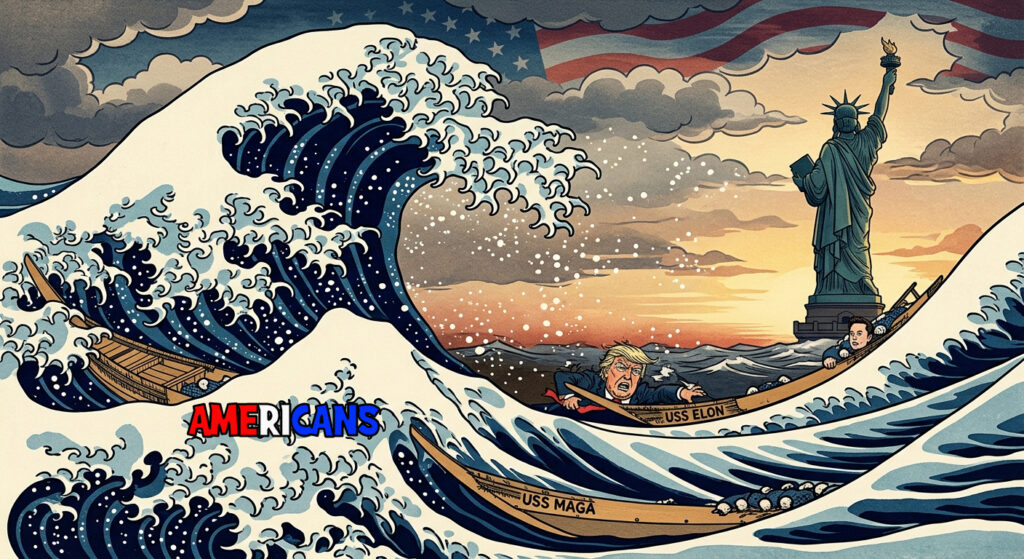
“Nature Yields to No King”
This editorial cartoon was inspired by Japanese artist Hokusai’s “The Great Wave off Kanagawa.” As a meditation on impermanence, the Blue Tsunami of 2026 stands as a stark harbinger of a shifting American landscape. It is a philosophical reminder to Washington’s elite: billionaire money and executive hubris can attempt to build walls, but they will always be swept away when the ocean of public desperation finally decides to move.
Disclosure: This editorial cartoon is an AI-generated image created via Nano Banana 2 based on conceptual prompts provided by this author.
In the closing weeks of October 2026, President Donald J. Trump pleaded with his MAGA base to “pretend I’m on the ballot.”
On November 3, 2026, America responded. What was predicted as a possible “blue wave” turned out to be a massive blue tsunami, catching many poll watchers off guard. The Democratic Party didn’t just gain a majority in the House of Representatives; they also flipped the Senate. Driven by massive turnout in an election cycle that historically sees tepid voter participation, the results were a staggering surprise. In the words of some TV political pundits, the Democrats truly outdid themselves.
Expectations vs Reality
Heading into the 2026 midterm elections, the Democratic Party held optimistic but cautious expectations of a blue wave that could flip control of both the House of Representatives and the Senate. This momentum was fueled by deep voter dissatisfaction over Trump’s handling of the war, high fuel prices, and anxiety over the cost of living. Democrats were confident they could reclaim the House majority (needing a baseline of 218 seats) by flipping just three seats to take control of the chamber. At the time of this writing, Democrats lead comfortably with 245 seats to the Republicans’ 147.
Flipping the Senate was seen as a much tougher task, considering the staggering amount of money billionaire donors poured into electing and defending Republican candidates. Elon Musk alone shelled out an estimated $483 million to super PACs supporting Republican candidates, with much of it targeting Texas, Musk’s adopted home state. Prior to the midterms, Republicans held a 53-to-47 seat advantage. A day after the elections, the tables have turned: Democrats are poised to control the chamber with 54 seats, alongside 2 independents, leaving Republicans with 44 seats. The most stunning victories occurred in historically conservative or highly competitive states, highlighted by wins from James Talarico (Texas), Adam Hamilton (Kansas), Annie Andrews (South Carolina), Roy Cooper (North Carolina), Sherrod Brown (Ohio), Josh Turek (Iowa), Troy Jackson (Maine), and Abdul El-Sayed (Michigan).
The Gargantuan Cost of Midterm Elections
According to media reports, the top 40 megadonors pumped an unprecedented $2.4 billion into the 2026 midterm elections by mid-October alone. To put that into perspective, that is roughly equivalent to what the entire government of Afghanistan spends in a single year to operate. All spent on a single election cycle—and not even a presidential one at that!
These megadonors did not line up behind just one party. While the top donors heavily favored Republicans this cycle by a three-to-one margin, significant funding flooded both sides. Strikingly, bipartisan big spenders—largely representing cryptocurrency, online gambling, AI, and pro-Israel interests—poured nearly as much money into both parties as the top donors who gave exclusively to Democrats. Prominent special interest entities leading this charge included crypto giants Coinbase and Ripple Labs.
Overall, ad industry tracker AdImpact reported that ad spending this cycle hit a staggering $11.6 billion, surpassing the $11.2 billion spent in the 2024 presidential election. OpenSecrets, a non-partisan research group tracking money in politics, pegged total spending for these midterms as on track to reach $11.9 billion.1
The Megadonors
I am betting my ass that Musk did not stake nearly half a billion dollars just to preserve budget cuts on “government waste.” He spent that money to protect his billions in equity and shield his 90-odd business entities in Texas alone.2 Now that the Democrats are poised to control state and national policies, his business concerns—which rely heavily on government contracts and largess, most notably SpaceX and Tesla—may face far greater legislative scrutiny.
SpaceX is heavily dependent on NASA and Department of Defense contracts, holding over $22 billion in federal awards. Tesla similarly grew and was nurtured by government support and favorable regulations over the years, including a $465 million Department of Energy loan in 2010. Furthermore, a massive slice of Tesla’s profits historically comes from selling regulatory and zero-emissions credits to traditional automakers unable to meet government fleet-emission standards.
Following the election, the immediate financial toll was evident. According to a report by the Turkish state-run news outlet Anadolu Agency, Elon Musk was poised to lose billions in valuation across his business holdings tied to the massive loss of Republican power. Tesla shares fell 5.7%, while SpaceX reportedly dropped 7.6% in early trading, putting immediate pressure on Musk’s fortune.
Musk wasn’t the only billionaire trying to shape the landscape. The second largest contributors to the Republican war chest were industrialists Richard and Elizabeth Uihlein, owners of the shipping and packaging giant Uline. In Silicon Valley, venture capitalists Marc Andreessen and Ben Horowitz focused their capital on shaping regulations around cryptocurrency and artificial intelligence. Hedge fund investor Jeff Yass aggressively pushed a school-choice agenda centered on private and charter school vouchers. Meanwhile, Miriam Adelson, majority owner of Las Vegas Sands, focused her influence on pro sports, gaming, and far-right pro-Israel policies.
Even the tech sector’s famous Winklevoss twins—Cameron and Tyler—poured money into the cycle. Best known from “The Social Network” for suing Mark Zuckerberg over the creation of Facebook, the brothers turned their landmark settlement and early Facebook stock into a massive $11 million investment in Bitcoin, becoming prominent figures in the crypto-political funding wave.
On the Democratic side, the party’s own PAC, Majority Forward, served as a primary financial engine. Coming in right behind them was the father-son duo of George and Alexander Soros, who contributed over $103 million while continuing to channel their family wealth into global philanthropic and civic causes. Former New York City Mayor Mike Bloomberg made a massive late-campaign push, dropping an additional $36 million just days before the election to bring his total contributions close to $116 million, with a heavy focus on gun safety advocacy. Rounding out the top individual Democratic backers was LinkedIn co-founder Reid Hoffman, who gave $16 million to a super PAC backing James Talarico’s historic Texas senate run while managing his broader business focus on high-emotional-intelligence AI models and therapeutic drug discovery.
With the dust settling on a multi-billion dollar battlefield, the map has been thoroughly redrawn, proving that even a historic deluge of conservative megadonor cash couldn’t stop the momentum of the blue tsunami.
The New Kids on the Political Donors Block
In 2010, an advocacy group successfully challenged the Bipartisan Campaign Reform Act of 2002, which had barred corporations and labor unions from airing election-related communications and ads endorsing or opposing a political candidate close to an election. That group was Citizens United, founded in 1988 as a non-profit membership organization dedicated to conservative political causes.
In the years prior to the landmark U.S. Supreme Court ruling in Citizens United v. Federal Election Commission, labor unions and traditional special interest groups played the dominant role in campaign contributions. However, in 2010, the nation’s highest court ruled that the government cannot restrict independent political expenditures by corporations, unions, and non-profit organizations, equating political spending with protected speech under the First Amendment.
The court’s decision split sharply along ideological lines. The five conservative justices—Anthony Kennedy, John Roberts, Antonin Scalia, Clarence Thomas, and Samuel Alito (appointed by Republican Presidents Reagan, George H.W. Bush, and George W. Bush)—outvoted the four dissenting liberal justices, John Paul Stevens, Ruth Bader Ginsburg, Stephen Breyer, and Sonia Sotomayor (appointed by Republican President Gerald Ford and Democratic Presidents Bill Clinton and Barack Obama).
This ruling triggered a rapid proliferation of “Super PACs”—political action committees capable of raising and spending unlimited sums from corporate entities and ultra-wealthy individuals. Ultimately, it sparked an explosion in election spending, ballooning from roughly half a billion dollars per cycle prior to the ruling to a staggering eleven-plus billion dollars today.
So, who holds the real power to influence an election? The ordinary citizen who can barely keep up with the soaring cost of gas and groceries, or the filthy wealthy megadonors with endless capital to spare? Guess whose interests indebted politicians are more likely to serve? And guess which party reaped the absolute largest share of that billionaire cash in this cycle?
The Catalysts for Change
Among the chief complaints voiced by the electorate were severe financial hardships tied to the high cost of groceries, gas, and utilities. Alongside deep-seated perceptions of government corruption and anxiety over executive power, the ongoing war involving Iran and the administration’s foreign policy missteps ranked at the very top of voter anxieties. Furthermore, harsh immigration enforcement provoked sharp backlash across the country.3
Historically, midterm elections suffer from chronically low voter turnout. In the U.S., presidential elections typically engage 55% to 67% of the voting-eligible population, but participation routinely plummets to 35% to 50% when the presidency is not on the ballot. Data demonstrates that this historic surge was heavily fueled by an unprecedented Latino turnout, alongside heightened engagement from young voters under 30 and a notable leftward shift among men.
The Finger-Pointing Begins
Shying away from any personal responsibility for the party’s losses, President Trump deflected blame entirely onto the candidates themselves, suggesting that voters simply “didn’t like the candidates.” He also blamed the war in Iran for hurting the campaign, even as he simultaneously defended his original decision to enter the conflict.
Vice President JD Vance issued an equally blunt assessment on social media, writing, “the reason we lost is the war,” conveniently sidestepping how the administration’s own geopolitical priorities triggered the domestic economic fallout.
True to form, House Speaker Mike Johnson refused to acknowledge any internal GOP faults, pointing his finger instead at a new breed of what he labeled “far-left radicals” and “socialists” within Democratic ranks, warning that they would turn Congress into a “circus” driven by political retaliation and “lawfare.”
Behind the scenes, the blame game quickly intensified as rank-and-file House Republicans fiercely criticized party leadership for the “brutal” defeats. Yet, according to media reports, party insiders are privately tearing into Trump, calling his deflection of blame absolute “nonsense” and arguing that the election was a direct, sweeping rejection of Trumpism.4
Quo Vadis?
Whither goest thou, America? Post-election, Trump countered by stating he is fully prepared to work with the new Democratic majorities, though he paired that openness with a firm warning that he will aggressively deploy his executive veto power against any legislation he opposes.
Political analysts from across the spectrum agree that with dual-chamber control, the electorate’s primary expectation will be an immediate ramp-up of congressional investigations and oversight into the executive branch. Already, just days after the election, talk is rife that impeachment proceedings against Secretary of Defense Pete Hegseth will immediately resume the moment Congress convenes. Both chambers have separate, pending articles of impeachment against Hegseth that were abruptly shelved when leadership prematurely forced a congressional recess before the midterms.
This shift in power is also poised to trigger a massive showdown over fiscal policy and budget constraints. On Election Day, Trump announced a sudden plan to completely cut off nearly $4 billion in annual military aid to Israel by the end of 2026, claiming in a Fox News interview that the country “doesn’t need it” anymore. While pro-Democratic pundits viewed the sudden policy shift as a tactical maneuver to neutralize a potent progressive talking point championed by figures like Michigan’s Abdul El-Sayed, a deeper calculation appears at play. Methinks ‘ol Donnie is anticipating a brutal legislative gridlock ahead, scrambling for a face-saving foreign policy pivot before he hits an immovable wall with anti-war proponents in the incoming Congress.
Pardon the Interruption, Hear my Two-Centavos Worth
The ballots have been counted, the seats have flipped, and the cable news pundits have crowned their winners. In the end, the 2026 midterms proved that while you can buy airwaves, algorithms, and political parties, you still cannot buy a mandate. The megadonors poured billions into a high-stakes chess match, only to have their entire board upended by the quiet, angry stroke of a pen held by working-class citizens who just wanted to afford breakfast, lunch and dinner in their family table. The elite were reminded that inside the ballot box, a billionaire’s dollar carries exactly the same weight as a voter’s desperation.
Yet, as the celebrations fade and the new majorities take their seats, a sharper, grimmer reality sets in. Winning a legislative majority is one thing; overcoming a heavily financed executive branch is another. While the pro-masses electees head to Washington championing structural change, Donald Trump still holds the ultimate trump card: a red hat emblazoned with the word “VETO” and a Rolodex of corporate titans ready to bankroll the resistance. The voters successfully changed the guards of Congress, but the true test now begins. The people proved they have the power to put their champions in the arena, but as long as a handful of billionaires retain the ear of the executive, the fight to turn that historic ballot into actual bread-and-butter relief remains an uphill battle against a system designed to protect the highest bidder.
- The Guardian
https://www.theguardian.com/us-news/ng-interactive/2026/nov/02/who-funded-midterms ↩︎ - The New York Times
https://www.nytimes.com/2026/02/27/technology/elon-musk-companies-texas.html ↩︎ - AP Voter Poll as reported by Public Broadcasting System (PBS)
https://www.pbs.org/newshour/politics/ap-voter-poll-voters-want-congress-to-impose-more-checks-on-an-unpopular-president ↩︎ - BBC Report
https://www.bbc.com/news/articles/c6x29rr8djy3o ↩︎


